

Brother Ginepro from Città di Castello to Assisi
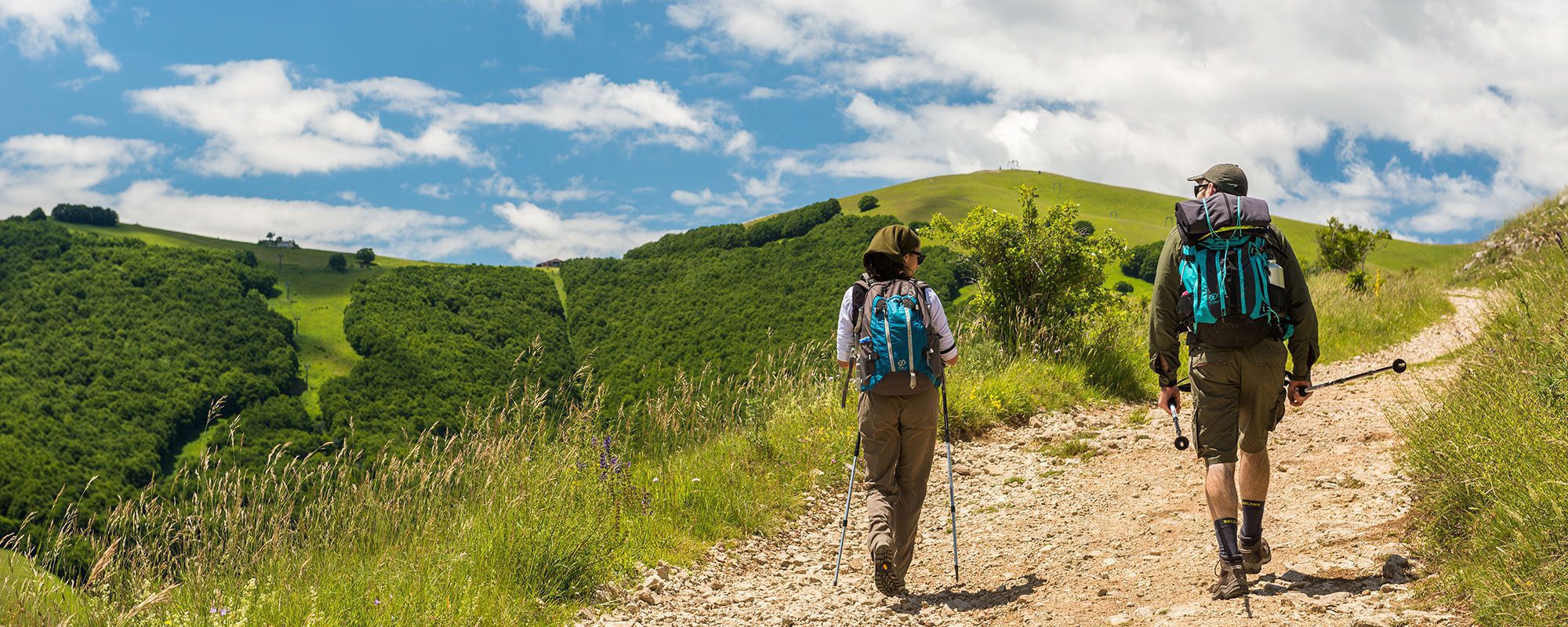
This section of the Via di Francesco follows part of the northern route, starting in Città di Castello and reaching Assisi. Although very different from one another, these two cities allow travelers to discover the varied artistic, cultural, and architectural nuances of the region, which gradually change as one progresses along the route. This package, dedicated to the figure of Fra Ginepro, leads through places rich in medieval atmosphere, unspoiled wooded landscapes, and offers the opportunity to fully immerse oneself in the beauty of the Way of Saint Francis.
Availability: departures available throughout the year
Duration: 7 nights and 6 days
Included services:
- half-board accommodation
- luggage transfer
- transfers as indicated in the program
- pilgrim’s credential
- cancellation, medical, and luggage insurance
- digital GPX maps
- telephone assistance by Francesco’s Ways
Extra services:
- packed lunch
- hiking guide
- transfers not included in the program
- anything not expressly listed under “Included Services”
Price per person:
- from €982 per person in a double room
- single room supplement on request
Itinerary
DAY 1 – From Città di Castello to Pietralunga
Leaving Città di Castello behind, the route gradually enters a natural landscape of shady woods and sun-exposed stretches, guiding the walker toward Pietralunga. After approximately six kilometers, the hamlet of Il Sasso is reached, the last opportunity to stock up on water and supplies before tackling a long ascent, followed by a descent leading to Pieve de’ Saddi, a site of great historical and religious significance in the Upper Tiber Valley. From here, the path winds through peaceful valleys and open fields, with continuous changes in elevation and several equipped rest areas along the way. The arrival in Pietralunga, a welcoming and compact Umbrian village, is a well-earned reward after a demanding day. This is a long stage, best approached at a steady pace, carefully managing one’s energy in view of the final stretch, marked by a descent followed by the last ascent.
DAY 2 – From Pietralunga to Gubbio
The second day offers a smooth and pleasant walk through forests and open clearings, with wide views over the surrounding landscape. After a stretch among conifers, the scenery changes abruptly upon entering the plain of Gubbio, where the agricultural landscape is defined by cultivated fields and rows of poplar trees. Near Loreto, the environment opens up even more: woodlands give way to farmland and small settlements. A stop is recommended at the Church of San Giovanni Battista, generally closed but accessible thanks to the presence of a caretaker, where one can rest in the shade before descending toward Abbadia di Piazza. From here, the route continues along paved roads, crossing sunny stretches interspersed with monumental oak trees, until reaching the “Fonte del Pellegrino,” a recent yet meaningful addition along the way. The arrival in Gubbio is particularly evocative: beyond the city’s charm, one strongly perceives its deep connection to Saint Francis. The route concludes in front of the church dedicated to him, where a statue depicts the saint alongside the wolf, recalling the famous episode that binds them.
DAY 3 – From Gubbio to Biscina
The original itinerary includes a single long stage from Gubbio to Valfabbrica; however, due to its considerable length and difficulty (approximately 36 km), it is divided into two days. This stretch is deeply marked by Franciscan memory: it was along this road that Francis described himself as the “herald of the Great King” in front of brigands and found shelter—though not without hardship—at the Abbey of Vallingegno, where he began performing humble tasks in the kitchen. Experiences that still speak powerfully to pilgrims today. Leaving Gubbio, the route initially follows paved roads, requiring due caution, before continuing on dirt tracks that climb toward the ridge, from which one can take a final look back at the city. The path then continues through woods, gentle hills, castles, and panoramic views of Mount Subasio. Near the small church of Madonna delle Grazie, a place dear to travelers, it is possible to pause for a moment of reflection. The route then climbs toward the Hermitage of San Pietro in Vigneto, where a fountain provides refreshment, before descending to Caprignone, an ideal shaded resting point. The final ascent to the Castle of Biscina is demanding, but it allows access to the last water source before the long descent—sun-exposed and paved—that leads toward Valfabbrica. Along the way, one also encounters the evocative Pieve of Coccorano.
DAY 4 – From Biscina to Valfabbrica
From the Castle of Biscina, a long and bright descent begins, mostly on paved roads, gently leading toward Valfabbrica. Before leaving the castle, it is possible to refill water supplies, as this is the last available point before arrival. The route is enhanced by the presence of the Pieve of Coccorano, a building of great charm set within the landscape. Valfabbrica presents itself as a sort of Franciscan “Monte do Gozo”: a place that invites pilgrims to slow down and reflect on the imminent conclusion of the journey and the approaching encounter with the tomb of Saint Francis in Assisi.
DAY 5 – From Valfabbrica to Assisi
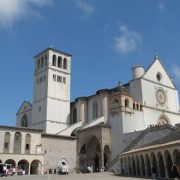
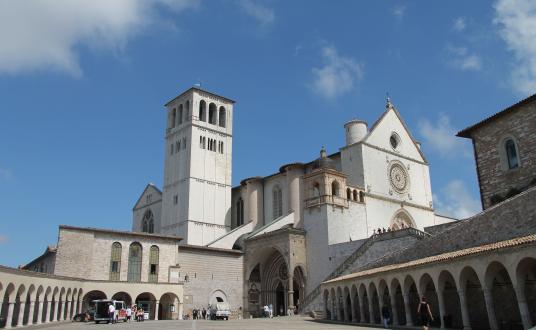
The final day of walking begins in the silence of the forest, creating an intimate and meditative atmosphere. After passing Pieve San Niccolò, the landscape gradually opens onto vineyards and olive groves, a clear sign of Assisi’s proximity. The route alternates ascents and descents, with some steeper sections, but the awareness of the nearby destination makes every step feel lighter. Suddenly, Assisi appears on the horizon, with the imposing profile of the Sacred Convent and the Basilica, offering one of the most moving moments of the entire itinerary. Shortly before entering the city, at Ponte de Galli, walkers may choose a scenic variant through the Bosco di San Francesco as an alternative to the paved road. Entry into Assisi is through Porta San Giacomo, the same gate used for centuries by pilgrims on their way to Santiago de Compostela. The Basilica of Saint Francis, bathed in sunlight, welcomes travelers at the end of the journey. Upon reaching the Saint’s Tomb, one may pause in quiet reflection, in the dim light illuminated by the eternal lamp. Finally, at the Statio Peregrinorum, pilgrims may collect the Testimonium, reserved for those who have walked at least 100 kilometers, or the Chartula Peregrini, as a tangible sign of the experience lived.